August 18, 2026 · 6 min read
How to Read a Luxury Watch Reference Number Before You Buy
by Timeless Elegance PH
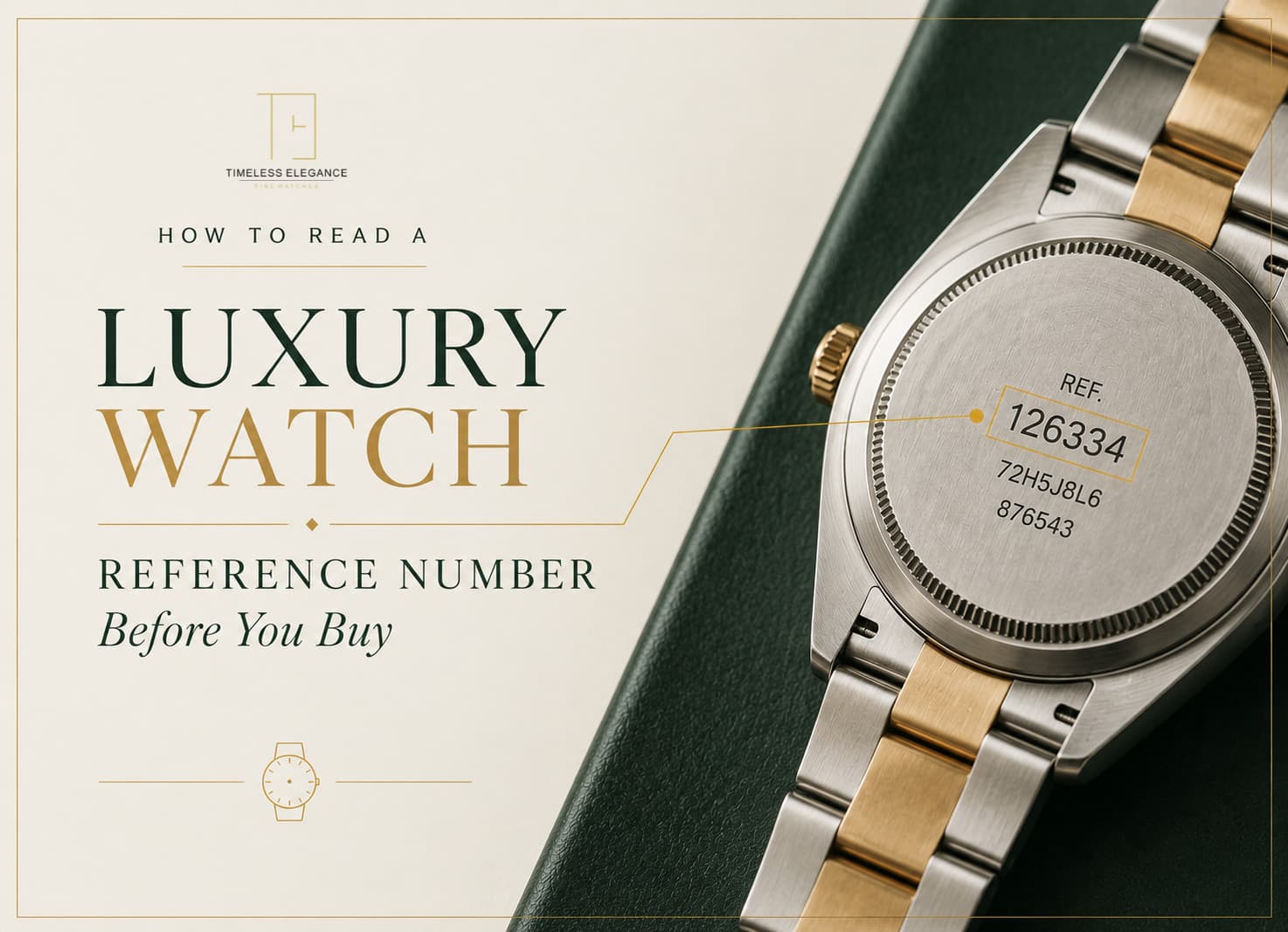
Ask an experienced collector about a watch and they will not start with the dial. They will ask for the reference. It is the shortest and most precise way to say exactly which watch is being sold — and reading one takes about a minute once you know what you are looking at.
Reference number vs. serial number
These two get confused constantly, and the difference matters. The reference number identifies the model and its exact configuration — case size, metal, bezel, dial, bracelet. Every watch built to that specification shares it. The serial number identifies your individual watch, the single piece that left the factory. One describes a design; the other describes an object.
For buying, the reference is the more useful of the two. It is what lets you compare a listing against the market, and against the photographs in front of you.
Where to find it
Depending on the brand and the era, the reference lives in one or more of these places:
- Engraved between the lugs at 12 o'clock, hidden under the bracelet — the traditional location on a Rolex and many others
- On the case back, either alone or beside the serial
- Printed on the guarantee card or warranty papers, next to the serial
- Inside the case back on some vintage pieces — a job for a watchmaker, not for a screwdriver at home
What the digits are telling you
There is no single industry standard — each brand encodes its own way — but the logic is consistent. A reference is built from segments, and each segment names a decision the factory made.
On a modern Rolex the leading digits identify the model family and case size, while the trailing digits describe the bezel and the metals. That is why two Datejusts that look quite different across a table can share most of a reference and part company only at the end. Omega's modern references are longer and more literal, running to a string that encodes collection, case, movement and dial in fixed positions. Cartier uses a shorter model reference, usually paired with an individual number on the case back.
You do not need to memorise any of this, and you should be wary of any chart that promises you can. What you need is the habit: get the full reference from the seller, then check it against the brand's own listing for that reference, or against a dealer who can read it for you. Ask the seller to decode it, and see whether their answer matches the watch.
The mismatch it catches
This is the practical payoff. Because a reference describes one exact configuration, it gives you a way to test whether a watch is what it claims to be. If the reference specifies a fluted white gold bezel and the photographs show a smooth steel one, something is wrong — a part was swapped, or the listing text was copied from somewhere else.
Watches assembled from the parts of several donors — collectors call them 'frankens' — survive a casual glance and fail a reference check. So do honest mistakes. A genuine watch wearing a replacement dial fitted during a past service is not a fake, but it is not the reference it is being sold as either, and it should not carry that price.
Three questions to ask before you pay
None of these cost you anything, and the order matters:
- What is the full reference number, and can I see it on the watch itself?
- Does that reference match what is printed on the papers?
- Does the configuration the reference describes match the watch in front of me?
A seller who knows their own stock answers all three without hesitation. A seller who deflects — 'it is the same model', 'the number does not really matter' — has told you something useful for free.
Every watch we list states its reference, and we will read it out with you, on the watch, before anything is agreed.
Browse the Collection
Every watch we list is verified, photographed honestly, and open to your questions.
See what’s in stock