August 11, 2026 · 5 min read
The Story Behind the Cartier Tank: How a Watch Became a Design Icon
by Timeless Elegance PH
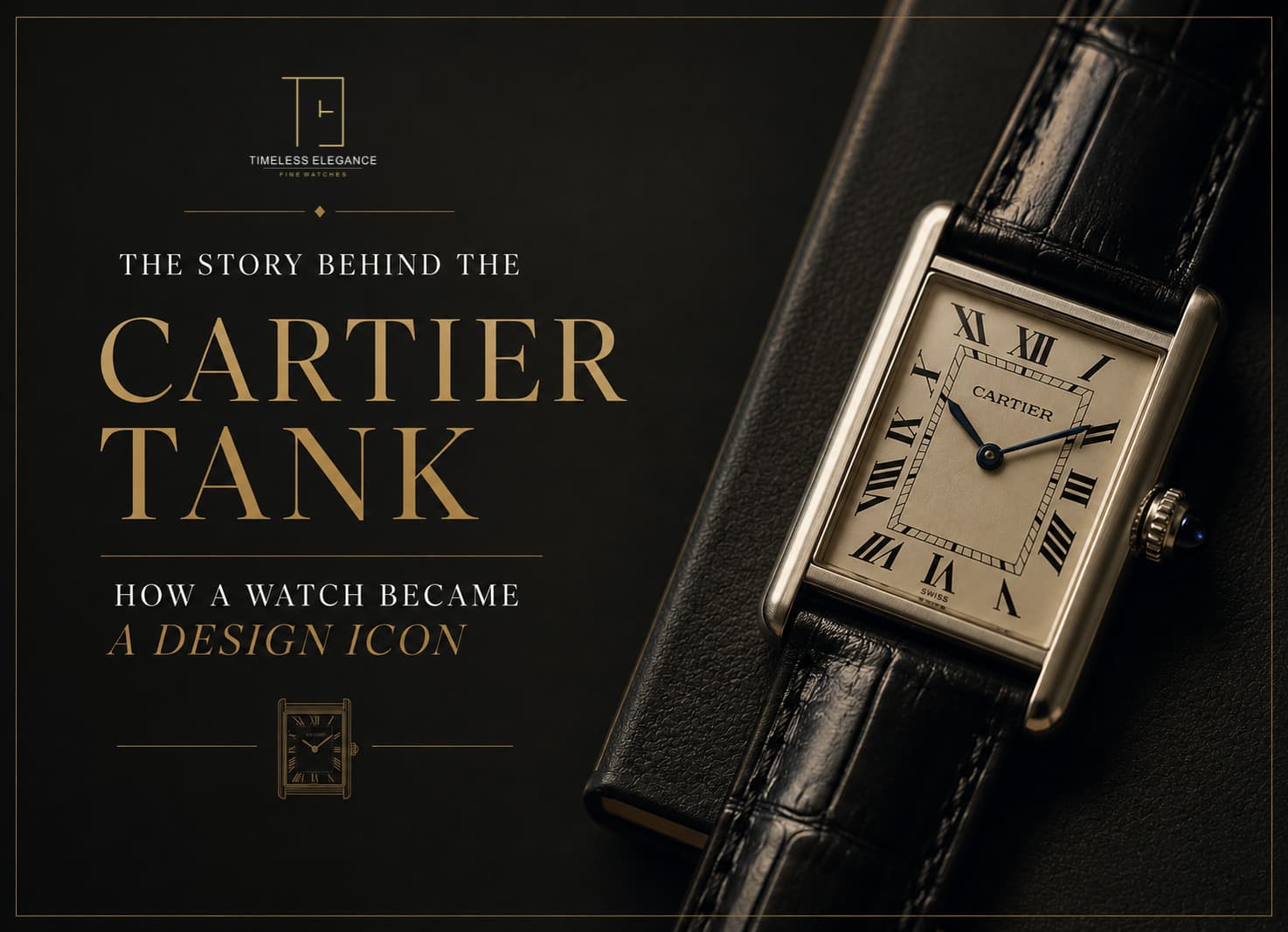
Some watches are admired. The Cartier Tank is copied. More than a century after Louis Cartier drew it, its silhouette is one of the very few in watchmaking that people recognise without reading a name on the dial — and that recognition is the whole point of the design.
1917: a shape borrowed from the battlefield
Louis Cartier conceived the Tank in 1917, in the final year of the First World War, and Cartier put it on sale in 1919. The name is not decoration. The design takes its geometry from a Renault FT tank seen from above, the two parallel treads becoming the two vertical bars that frame the dial.
Those bars — Cartier calls them brancards — are the reason a Tank looks the way it does. They are not lugs bolted onto a case. They run the full height of the watch, and the strap disappears between them, so case and strap read as one continuous line down the wrist. It is why a Tank looks composed on almost any arm.
What makes a Tank a Tank
Strip away the variations and the same design grammar appears every time:
- Brancards — the parallel side bars, unbroken from top to bottom
- A rectangular dial, usually cream or silvered, with Roman numerals
- A railway-track minute chapter printed just inside the numerals
- Blued steel sword hands
- A crown set with a cabochon, traditionally sapphire or spinel
Change any one of them and the watch still works. Change two and it stops being a Tank.
One design, a whole family
The Tank has been reinterpreted continually without ever being redrawn. The Tank Louis Cartier keeps the original's softly rounded brancards and its gold dress-watch character. The Tank Francaise brought an integrated metal bracelet and a sportier stance in the 1990s. The Tank Americaine stretched the case long and curved it to the wrist. The Tank Must revived the lean, quartz-driven versions that put a Cartier on a great many wrists through the 1970s and 80s, and has returned as a modern collection.
For a first Cartier this is good news. The family spans a wide range of sizes, budgets and levels of formality, and all of it still reads, instantly, as a Tank.
Why it has lasted
Three reasons, and none of them is technical. It is small — the Tank never joined the arms race toward ever-larger cases, so it still wears the way a dress watch should. It was unisex by design, decades before that became a marketing category. And it is reduced to the point where there is simply nothing left to date.
A Tank from the 1970s and one bought this year sit beside each other as two versions of the same idea, not as old and new. Very few designs in any field survive that test.
Buying one pre-owned
A few things worth knowing before you commit:
- Quartz is not a lesser Tank. Many of the most loved references are quartz, and Cartier has never treated them as second tier.
- Size on paper misleads. A rectangular case wears quite differently from a round one — try it on your own wrist before deciding.
- Check the case edges. The crisp brancard lines are the first thing an aggressive polish softens.
- Look closely at the cabochon and crown, a common replacement point, and at the strap attachment where the leather meets the bars.
We are glad to talk you through a Tank in person, including which references we would steer a first-time buyer toward — and which we would not.
Browse the Collection
Every watch we list is verified, photographed honestly, and open to your questions.
See what’s in stock