August 7, 2026 · 5 min read
What Does 'Unpolished' Mean on a Luxury Watch?
by Timeless Elegance PH
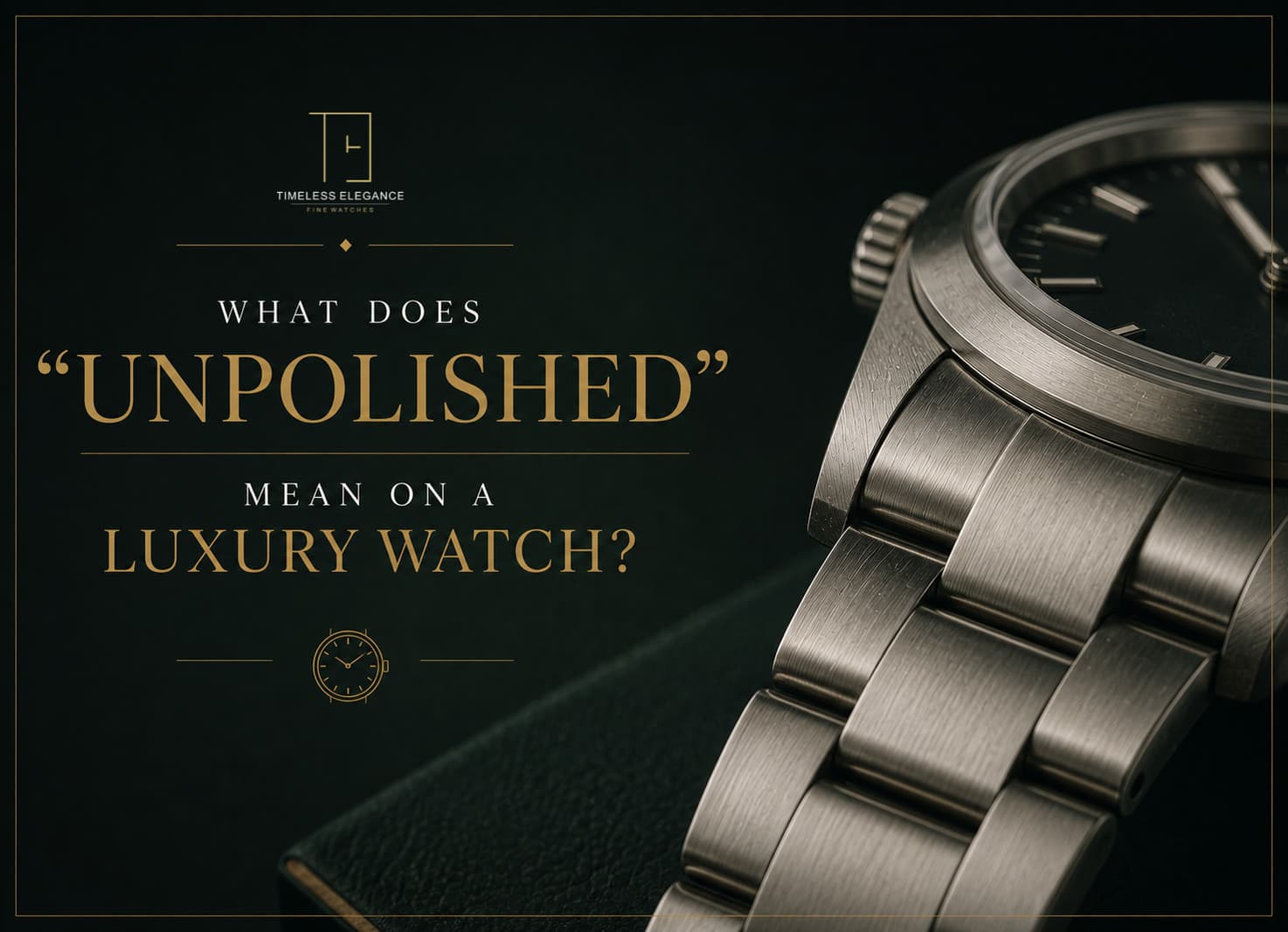
'Unpolished' turns up in listings as a selling point, often with a premium attached, and it is one of the few condition words in this market that means something precise. It does not mean the watch is flawless. It usually means close to the opposite — and that is exactly why it is valuable.
Polishing removes metal, not scratches
This is the part most first-time buyers miss. A polish does not fill a scratch. It grinds the surrounding surface down until the scratch is no longer there. The metal is gone.
Do it once, lightly, and the loss is invisible. Do it repeatedly, or once carelessly, and the case changes shape: sharp edges soften into curves, the flat bevel along a lug rounds over, and the crisp border between a brushed top surface and a polished flank blurs into one shiny mass. The watch gets a little smaller and a little gentler every time.
What the word claims, and what it does not
Unpolished claims exactly one thing: the case has never been refinished since it left the factory, so its geometry is the geometry the manufacturer intended.
It does not claim the watch is mint. An unpolished case usually carries its life honestly — desk marks, a ding on the clasp, hairlines across the case back. A heavily worn unpolished watch and a lightly worn polished one can sit at the same price for entirely opposite reasons.
Why collectors pay for it
Because originality cannot be restored. Nearly everything else on a watch can be serviced or replaced back to health — the movement, the crystal, the gaskets, even the dial. Metal that has been polished away is gone permanently, and the proportions that made the design look right go with it.
On models where the case shape is the design — the lug width of a Submariner, the brancards of a Tank, the chamfer on a vintage Datejust — an unpolished example is simply a more accurate copy of the watch the designer drew. Scarcity does the rest: the number of unpolished examples only ever goes down.
When a polish is completely fine
Most of the time, honestly. If you are buying a watch to wear daily rather than to collect, a well-executed refinish by a competent watchmaker makes a tired case look cared for, and there is nothing wrong with that. Plenty of superb watches have been polished once in forty years and are the better for it.
The problem is only at the extremes: an over-polished case sold at unpolished prices, or a seller who does not know which of the two they are holding. Either way you are being asked to pay for something you are not getting.
How to tell what you are looking at
You do not need a loupe and twenty years of experience for the obvious cases:
- Run a fingernail along a lug edge. An original bevel feels like an edge; an over-polished one feels like a curve.
- Find the transition between brushed and polished surfaces. It should be a crisp border, not a gradient.
- Check the engravings between the lugs, on the case back and on the clasp. Shallow, soft or partly missing text means metal has come off.
- Compare lug thickness against a known original. Thin, tapering lugs are the classic sign of a case polished several times.
And ask the seller outright. 'Has this case ever been polished?' is a fair question, and the answer — including an honest 'I am not sure' — tells you how well they know their own stock.
Our listings describe case condition as we find it, polished or not, with photographs that show the wear rather than hide it.
Browse the Collection
Every watch we list is verified, photographed honestly, and open to your questions.
See what’s in stock